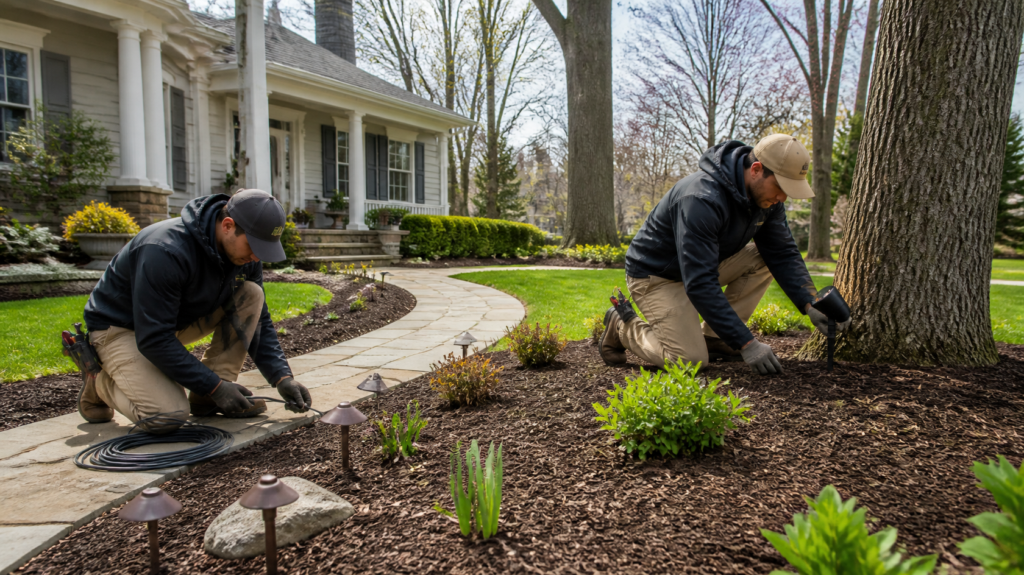
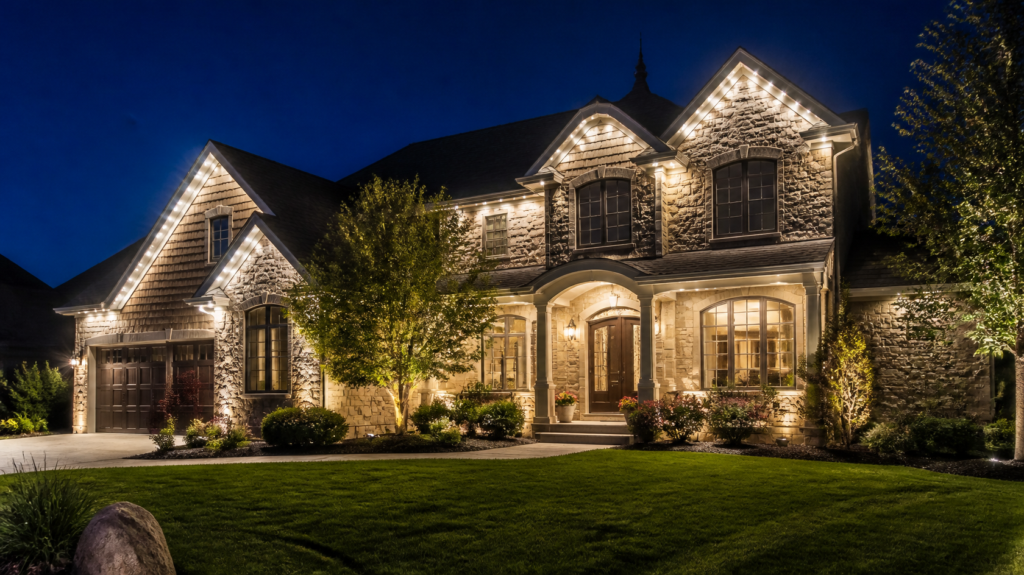
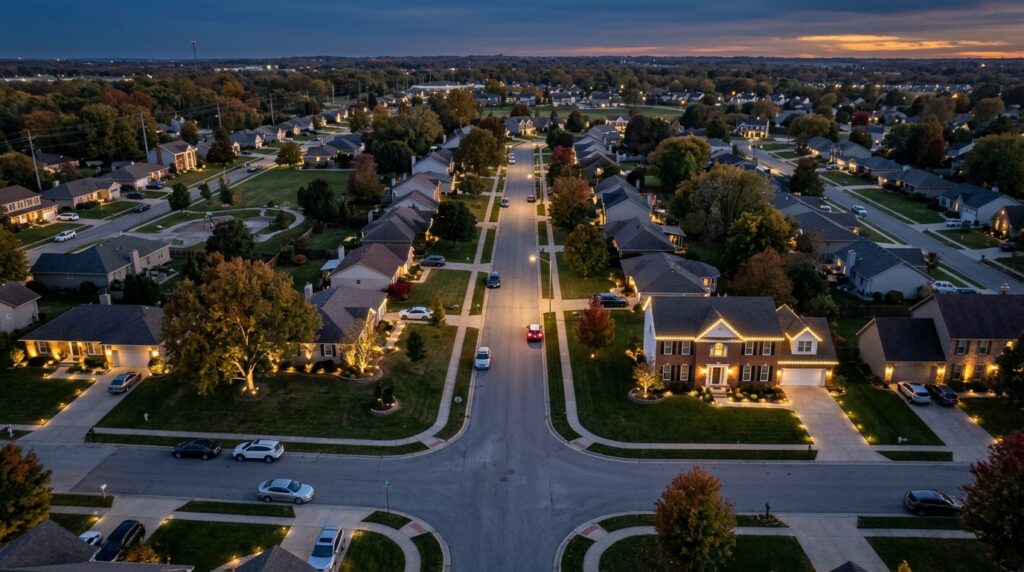
November in Johnson County means raking the last of the leaves, putting the patio furniture in the garage, and if you’re a homeowner who’s been meaning to improve your yard’s lighting finally having the mental space to think through what you actually want done in the spring.
That’s not a coincidence. The November-through-January window is when the best landscape lighting projects in Overland Park, Lenexa, Shawnee, and Leawood get planned. Not installed planned. And there’s a real advantage to doing it this way.
Homeowners who plan their landscape lighting projects over winter and book their contractor in January or February consistently get better scheduling, better pricing conversations, and better results than homeowners who call in April hoping to get on the spring calendar. The spring rush in Johnson County starts earlier than most people expect and the best installation windows fill up fast.
This guide walks through the exact steps Johnson County homeowners use to plan a spring landscape lighting project over winter from the first walkthrough of your property to the final punch list before install day.
Step 1: Do a Winter Walkthrough Darkness Is Your Best Design Tool
The single most useful thing you can do to plan a landscape lighting project is walk your property at night in the winter. Not with flashlights, not on a summer evening when everything looks fine at night, in November or December, when it’s dark by 5:30 PM and your yard looks exactly the way it will for six months of the year.
What you’re looking for:
| 🌳Feature trees and focal pointsWhat trees or plantings readas shapes against the sky?Which ones are worth uplighting?(See tree uplighting guide →) | 🚗Driveway & entry approachHow does your entry lookafter dark from the street?Path lighting gaps?Bollards or in-ground needed? | 🏠Architecture & rooflineWhich exterior walls are flatand uninteresting at night?Grazing light opportunity?Facade wash candidates? | ⚠️Dark spots & safety gapsSteps, grade changes, cornersWhere do you feel unsafe?Motion sensor zones?Gate and side-yard coverage? |
Take photos on your phone during this walkthrough. A simple photo log one shot per area you want to address becomes your working brief when you talk to a contractor. You don’t need to know what fixture goes where; you just need to know what problems you want solved and what features you want highlighted.
| Johnson County tip: winter tree structure |
| December and January are actually the best months to assess tree lighting potential in Johnson County. |
| Deciduous trees have dropped their leaves you can see the branch structure clearly and plan uplighting placement without guessing where summer foliage will block the beam. |
| Mark trees you want lit with a stake or ribbon during your walkthrough. Your contractor will thank you. |
Step 2: Organize Your Property into Lighting Zones
Once you’ve done your winter walkthrough, the next step is organizing what you saw into zones. Most Johnson County homes have four to six natural lighting zones areas that function independently and can be designed, quoted, and installed as separate scope items.
Thinking in zones gives you flexibility. You can prioritize the zones that matter most if budget is a constraint, and you can add zones in future phases without redoing earlier work.
| Zone | What It Covers | Typical Johnson County Priority |
| Front Entry | Driveway approach, front walk, door surround, porch | High street-facing, immediate curb appeal impact |
| Landscape Beds | Foundation plantings, garden beds, low shrubs | High frames the home, ties entry to facade |
| Feature Trees | Specimen trees, ornamental trees, large deciduous | Medium-High strongest visual impact for budget |
| Backyard / Patio | Deck, patio perimeter, outdoor living space | Medium personal enjoyment, outdoor entertaining |
| Side Yards | Gate areas, utility areas, grade changes, steps | Medium safety, often overlooked |
| Driveway Edges | Bollards or path lights along driveway length | Lower aesthetic upgrade, adds to curb appeal |
You don’t have to do all six zones at once. Many Johnson County homeowners start with the front entry and landscape beds the two zones with the highest visual return and add feature trees and backyard zones in a second phase the following year. A good contractor will design with future phases in mind so wiring and transformer capacity don’t need to be revisited.
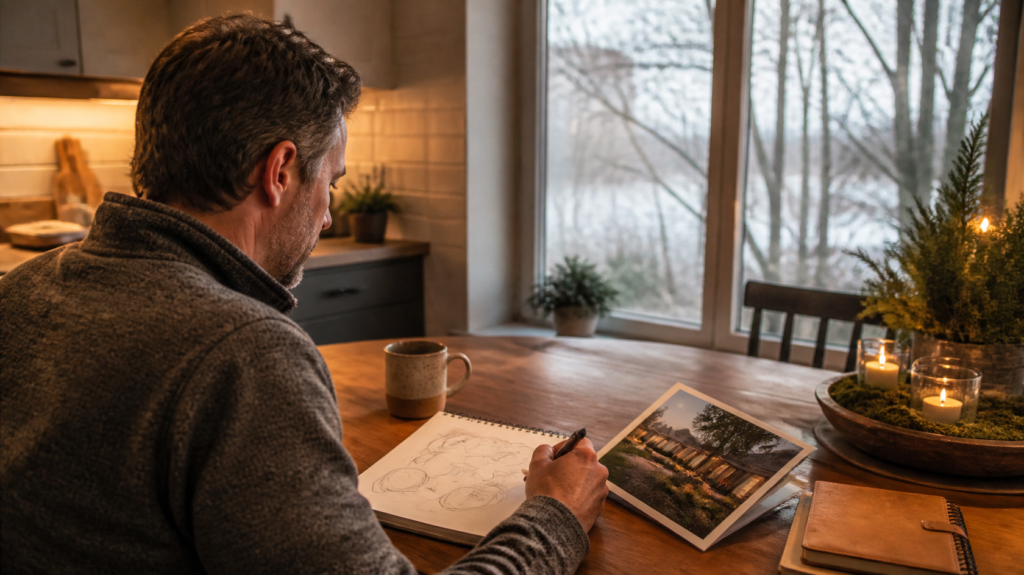
Step 3: Learn the Fixture Types Before Your Contractor Meeting
You don’t need to be a lighting expert to plan a great project. But knowing the basic fixture categories before your contractor consultation means the meeting is more productive you can say “I want the oak uplighted” instead of “I want something on that big tree,” and the contractor can jump straight to design rather than education.
| Fixture Type | Best Use | Common Placement in Johnson County Yards |
| Uplights | Trees, shrubs, architectural features | Buried at base of trees, aimed up at 30–45°; in-ground near foundation corners |
| Path lights | Walkways, driveway edges, garden borders | Every 6–8 feet along walks; staggered not opposed for natural rhythm |
| Well lights | In-grade feature lighting, flagpoles, columns | Flush with ground; used where bollards would be tripping hazard |
| Spotlights / MR16 | Focal point wash, facade detail, art or sculpture | Mounted on stakes or surface; directional beam 15°–60° depending on target |
| Downlights | Overhead coverage from trees or eaves | Mounted 15–20 ft up for moonlighting effect under large deciduous trees |
| Step lights | Deck steps, grade changes, retaining walls | Surface-mounted in riser or in-grade on stair edge |
For Johnson County yards with mature trees, uplighting is typically the highest-impact fixture type per dollar. A single well-placed uplight on a 40-year oak transforms your front yard at night more than a dozen path lights along your sidewalk. See our tree uplighting guide for Johnson County for beam angle selection, color temperature choices, and fixture placement for the most common tree types in Johnson County.
Step 4: Set a Realistic Budget for Johnson County Landscape Lighting
The most useful thing you can do before meeting with a contractor is arrive with a budget range in mind not a fixed number, but a range you’ve thought through. Contractors can design to almost any budget, but they need a starting point. Without one, quotes default to the full scope, which can feel overwhelming.
Here’s a practical reference for Johnson County homes in the $450K–$800K range:
| Project Scope | Typical Investment | What It Covers |
| Entry & beds Phase 1 | $1,200–$2,000 | Front walk path lights, 4–6 foundation uplights, transformer |
| Entry + feature trees | $2,000–$3,500 | Above + 2–3 tree uplights, driveway approach lighting |
| Full front yard | $3,000–$5,000 | All front zones: entry, beds, 3–4 trees, driveway edges |
| Full property | $5,000–$9,000+ | All front zones + backyard patio, side yards, feature lighting |
| Backyard patio only | $1,500–$3,000 | Deck/patio perimeter, step lights, small accent features |
| Budget tip: transformer capacity matters |
| Every landscape lighting system runs through a low-voltage transformer. Transformer capacity (measured in watts) determines how many fixtures you can add later. |
| If you plan to expand your system in future phases, ask your contractor to spec a transformer with 50–100W of headroom above your Phase 1 load. |
| The cost difference between a 150W and a 300W transformer is typically $50–$150 a small upfront cost that makes future expansion easy. |
Step 5: What to Look for in a Johnson County Landscape Lighting Contractor
Johnson County homeowners have several options for landscape lighting installation national franchise lighting companies, general electricians who add lighting as a side service, and dedicated outdoor lighting specialists. The differences matter, especially for projects over $2,500.
| Contractor Type | Advantages | Watch Out For |
| Outdoor lighting specialist | Deep product knowledge, design-focused, warranty support | Fewer in market; book earlier |
| National franchise (e.g. OLP) | Established process, training standards | Franchise pricing premiums; less local flexibility |
| General electrician | Can do high-voltage tie-ins | Less landscape design experience; may upsize unnecessarily |
| Landscaper add-on | Convenient if bundling | Lighting often subbed out; less accountability on quality |
Questions to ask any Johnson County landscape lighting contractor before booking:
▸ Do you provide a written design drawing before installation?
▸ What brand of fixtures do you use, and what’s the warranty on them?
▸ Who does the installation your employees or subcontractors?
▸ Do you offer a maintenance plan or annual checkup service?
▸ What’s your transformer sizing process for a system that might expand?
▸ Can I see examples of your work in Johnson County (Overland Park, Lenexa, Leawood)?
| Why Tropical Lighting for Johnson County |
| ✔ Local crew not a franchise. We’ve been installing in Johnson County since 2011. |
| ✔ Written design walk-through before every install you approve the plan before any work starts. |
| ✔ Low-voltage LED systems energy efficient, long-lasting, no licensed electrician required. |
| ✔ Flat-rate quotes with no surprises same-day or next-day response on all estimates. |
| ✔ We also install permanent outdoor LED (Oelo) if you want year-round roofline lighting alongside your landscape system. |
| Step 6: Book in Winter Beat the Spring Rush |
Step 6: Book Your Installation in January or February Before the Spring Rush
Here’s the part most Johnson County homeowners miss: the spring landscape lighting backlog starts in February, not April. By the time the tulips are up and homeowners are thinking about outdoor projects, the best installation slots in Overland Park and Lenexa are already 4–6 weeks out.
Winter planning turns into a real competitive advantage:
| Booking Window | Typical Scheduling | What You Get |
| January | 1–2 week install window | Best slot selection; first-available spring dates |
| February | 2–3 week install window | Good availability; pre-rush pricing conversations |
| March | 3–5 week wait typical | Spring rush beginning; scheduling pressure |
| April | 4–6+ week wait | Peak demand; limited flexibility on timing |
| May | 6–8 week wait common | Hardest to get a slot; backlog fully built |
The sweet spot for Johnson County homeowners is booking a consultation in December or January for a late-February or early-March install date. You get your system in the ground before the spring entertaining season, before the mulch goes down, and before crews are stretched thin. Request a free quote here and we’ll schedule your consultation for this winter.
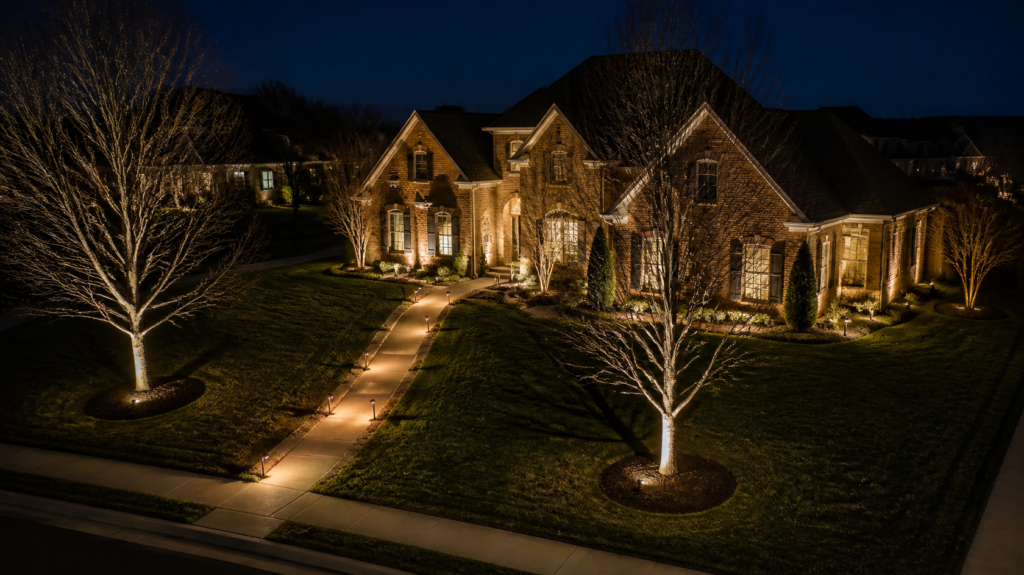
Your Winter-to-Spring Planning Timeline
Here’s a simple timeline for a Johnson County homeowner planning a spring landscape lighting install:
| When | Action | What It Accomplishes |
| November | Do your winter walkthrough | Identifies problem areas, feature candidates, zone priorities while trees are bare |
| November–December | Gather inspiration photos | Saves time in contractor meeting; keeps design on track |
| December | Request quotes from 1–2 contractors | Secures consultation slots before January rush |
| January | Review designs, finalize scope & budget | Lets you compare proposals without scheduling pressure |
| January–February | Book your install date | Gets you a spring slot before the backlog builds |
| March–April | Installation | System installed before spring entertaining season begins |
| April–May | Walk-through & fine-tuning | Adjust aim points, add zones, confirm coverage |
If you’d like to think through which zones make sense to prioritize for your property, our team offers free phone consultations for Johnson County homeowners no commitment required. See our full landscape lighting services page for what’s included in every installation, or request a quote here.
FAQs: Landscape Lighting Planning in Johnson County, KS
| Q: When is the best time to plan a landscape lighting project in Johnson County? |
| November through January is the best planning window. Days are short and dark, so you can walk your property at night and see exactly what needs lighting. Trees are bare, which makes it easier to assess uplighting potential. And booking a contractor in January or February gets you a spring install slot before the spring backlog builds. |
| Q: How much does landscape lighting cost in Johnson County? |
| Most Johnson County homes in the $450K–$700K range invest $1,200–$5,000 for a Phase 1 installation covering the front entry, foundation beds, and 2–4 feature trees. Full-property installs (front + backyard) typically run $5,000–$9,000+. Tropical Lighting provides flat-rate quotes with no surprises request one at tropical-lighting.com/contact-outdoor-lighting-mission-ks/ |
| Q: Should I use LED fixtures for landscape lighting? |
| Yes. Low-voltage LED landscape fixtures are the standard for new installations in Johnson County. They use 75–80% less energy than halogen, last 25,000–50,000 hours (vs. 1,000–2,000 for halogen), and require far less maintenance. The color temperature range (2700K–3000K warm white is typical for residential) is now excellent across the price spectrum. |
| Q: What’s the difference between landscape lighting and permanent outdoor LED (like Oelo)? |
| Landscape lighting (uplights, path lights, spotlights) lights your yard trees, beds, walkways, and architectural features at ground level. Permanent outdoor LED like Oelo is mounted in your roofline and lights the exterior of your home, changing colors through an app. Many Johnson County homeowners install both landscape lighting for the yard, permanent LED for the roofline. See our permanent LED article for more detail. |
| Q: Can landscape lighting be installed in phases? |
| Yes and for most Johnson County projects, phased installation makes sense. Phase 1 is typically the front entry and foundation beds (highest curb appeal impact per dollar). Phase 2 adds feature trees and driveway edges. Phase 3 might be the backyard and patio. The key is telling your contractor you plan to expand they’ll spec the transformer with extra capacity so Phase 2 and 3 don’t require rewiring. |
| Q: Does landscape lighting add value to a home in Johnson County? |
| Yes, in a market where median home values run $450,000–$700,000+, outdoor lighting is consistently cited by real estate professionals as one of the highest-ROI curb appeal improvements. Well-designed landscape lighting improves the home’s appearance at night which is when it’s seen during evening showings, by neighbors, and during winter months when it’s dark by 5:30 PM. |
Schema note for Bilal: Add FAQPage schema to this post. Each Q&A above maps to one FAQ item.
Start Planning Now Get the Spring Slot You Want
The best landscape lighting projects in Johnson County don’t happen in April. They get planned in November and December, designed in January, and installed in March before the spring backlog hits. If you’ve been meaning to improve your yard’s outdoor lighting, this winter is the best time to start.
Tropical Lighting has been designing and installing landscape lighting in Overland Park, Lenexa, Shawnee, Leawood, and surrounding Johnson County communities since 2011. Every project starts with a free walkthrough consultation we come to your property, walk the zones with you, and put together a written plan before any work begins. Request your free consultation here we respond same day or next day.