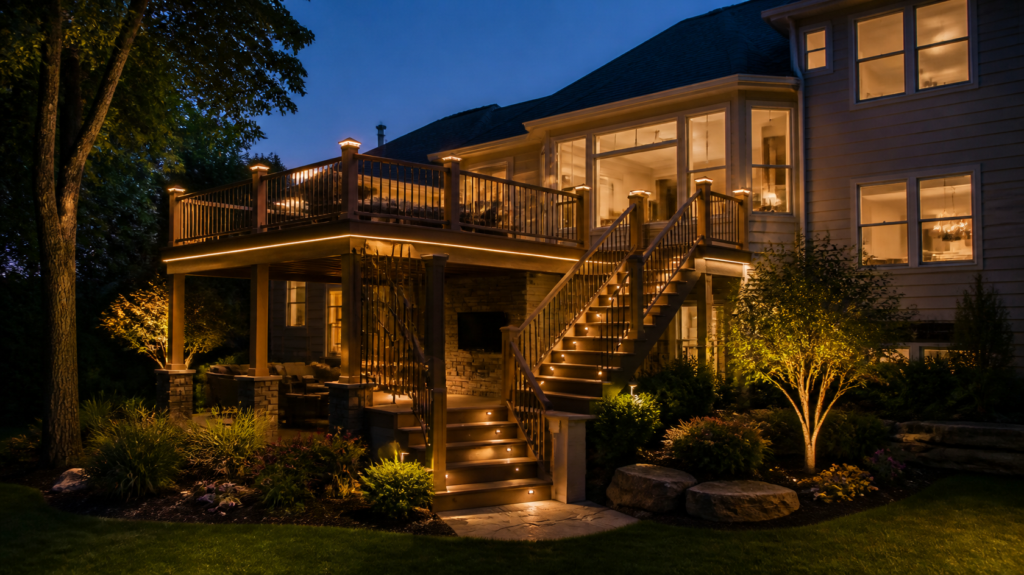
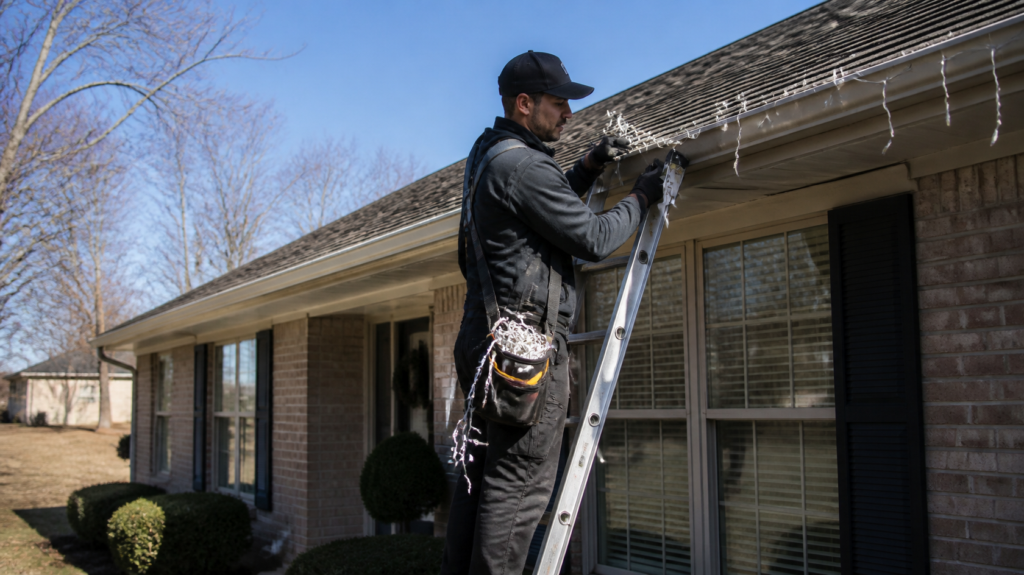
If you’ve been thinking about adding outdoor lighting to your Johnson County home but aren’t sure where to start, what it costs, or whether you need a professional this guide covers everything you need to know.
Low-voltage landscape lighting is the standard for residential outdoor lighting. It runs on 12V power (safe to touch, easy to work with), uses LED fixtures that last years without bulb changes, and transforms the way a yard looks after dark. This guide walks you through how the system works, what fixture types exist, how to design a layout, what professional installation costs in Johnson County, and how to decide whether to DIY or hire someone.
| Typical System Voltage12V AC | Average Install Cost$1,200–$4,500+ | LED Fixture Lifespan25,000–50,000 hrs | Transformer Life10–15 years |
What Is Low-Voltage Landscape Lighting?
Low-voltage landscape lighting is an outdoor lighting system that operates at 12 volts AC compared to the standard 120V household current. The transformer plugs into a standard outdoor outlet and steps down the voltage before distributing power to fixtures through buried or surface-laid cable.
The 12V standard emerged in residential outdoor lighting in the 1970s and became the dominant technology by the 1990s, when LED fixtures made it even more practical. Today, virtually every professional landscape lighting installation uses low-voltage LED for three reasons: safety (12V won’t cause serious injury if wiring is nicked during digging), energy efficiency (LED uses 75–80% less power than incandescent), and longevity (LED fixtures commonly last 10+ years without lamp replacement).
| Low-voltage vs. line-voltage: the key differenceLine-voltage systems run at 120V (the same as your indoor outlets). They were used in older landscape lighting but have been almost entirely replaced by 12V low-voltage systems in residential applications. If you have an older home with outdoor lighting that runs hot, flickers, or requires frequent bulb changes, it may be a line-voltage system worth replacing. |
How a Low-Voltage Landscape Lighting System Works
Every low-voltage landscape lighting system has four components: a transformer, cable, connectors, and fixtures. Understanding how they relate helps you plan a system or evaluate a quote from a contractor.
The Transformer
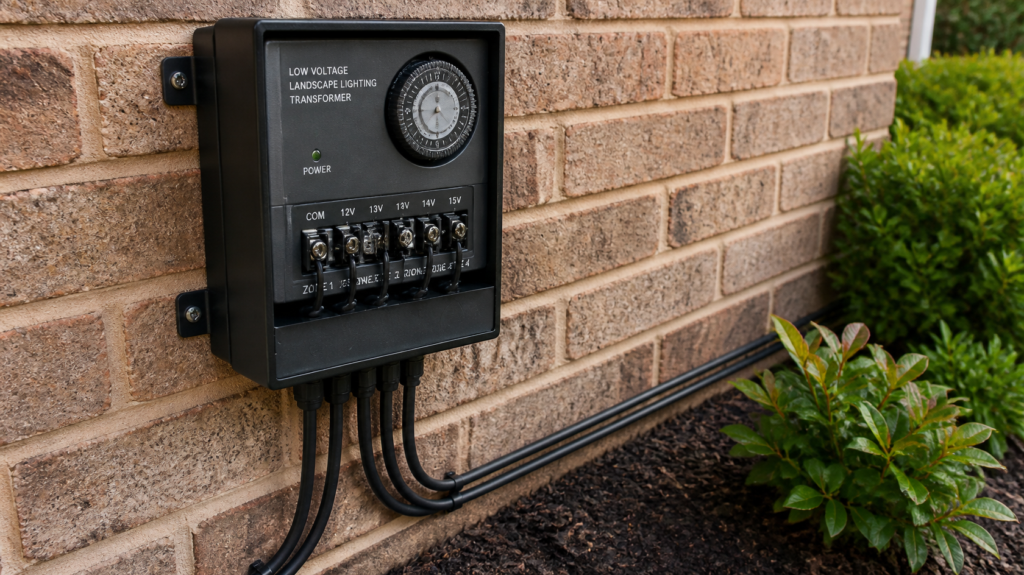
The transformer is the control center. It plugs into a standard GFCI outdoor outlet, steps 120V down to 12V, and distributes power through cable runs to all fixtures. Modern transformers include:
- Timer or photocell: automatically turns the system on at dusk and off at a set hour or at dawn
- Zone control: allows different lighting circuits to run on different schedules
- Wattage capacity: typically 150W to 600W for residential; this determines how many fixtures you can run
Sizing the transformer correctly is one of the most common DIY mistakes. The rule of thumb: add up the wattage of every fixture you plan to install, multiply by 1.25 for a 25% safety buffer, and that’s your minimum transformer size. Under-loading is fine. Overloading causes dimming and premature transformer failure.
| Transformer | Max Fixture Count (5W avg) | Best For | Price Range |
| 150W | ~24 fixtures | Small front yard, 6–10 fixtures with buffer | $80–$150 |
| 300W | ~48 fixtures | Average residential front yard + side beds | $140–$280 |
| 600W | ~96 fixtures | Full property or multi-zone design | $280–$500 |
| 900W+ | ~144+ fixtures | Large estate or commercial property | $500+ |
The Cable
Low-voltage cable is typically 12-gauge or 10-gauge direct-burial wire. It runs from the transformer to each fixture, either buried 3–6 inches underground or laid under mulch or ground cover. For Johnson County’s freeze-thaw cycles, burying cable at least 3–4 inches is recommended to prevent frost heave from lifting cable to the surface over winter.
Cable runs have a maximum effective length. As wire runs longer, voltage drops fixtures at the end of a long run will be dimmer than those near the transformer. Professional installers design cable runs in a hub-and-spoke or daisy-chain layout to minimize voltage drop and balance the system.
The Fixtures
Fixtures connect to the cable via a piercing connector or hardwired splice. Modern LED landscape fixtures come in a range of types the section below covers the main categories and when to use each.
Landscape Lighting Fixture Types: Which to Use and Where
Choosing the wrong fixture for a location is the most visible design mistake in landscape lighting. Each fixture type has a job using it where it doesn’t fit results in a system that looks cluttered, over-lit, or poorly placed. Here’s the breakdown:
| Fixture Type | What It Does | Best Used For | Typical Wattage |
| Uplights / Spotlights | Directs a focused beam upward at a vertical surface or object | Trees, architectural features, columns, walls | 3–10W per fixture |
| Path Lights | Low-profile bollard or mushroom fixture lighting the ground plane | Driveways, walkways, garden bed edges, steps | 2–5W per fixture |
| Flood Lights | Wide-angle beam for large flat surfaces | Side of house, wide garden walls, retaining walls | 10–20W per fixture |
| Bullet / Accent Lights | Narrow-beam directional fixture on a stake | Statues, specimen plants, focal points | 3–8W per fixture |
| Downlights / Moon Lights | Mounted high in a tree or structure, casts natural-looking downward light | Under mature trees, pergolas, patio overheads | 5–15W per fixture |
| Step / Wall Lights | Flush or recessed into risers, walls, or pillars | Steps, retaining walls, columns, low walls | 2–5W per fixture |
| Underwater / Pond Lights | Submersible LED for water features | Ponds, fountains, birdbaths, streams | 3–10W per fixture |
| Johnson County note: shade trees and uplightingOverland Park, Leawood, Lenexa, and much of eastern Johnson County have mature tree canopy many homes have oaks, maples, or elms 40–60 feet tall. Uplighting mature trees with 10W–15W LED fixtures creates dramatic, proportional light. Under-powered fixtures (3–4W) disappear against a large canopy. If you’re uplighting mature trees in JC, budget for fixtures with more output than the entry-level options you’ll see at big-box stores. |
Color Temperature: Warm White vs. Cool White
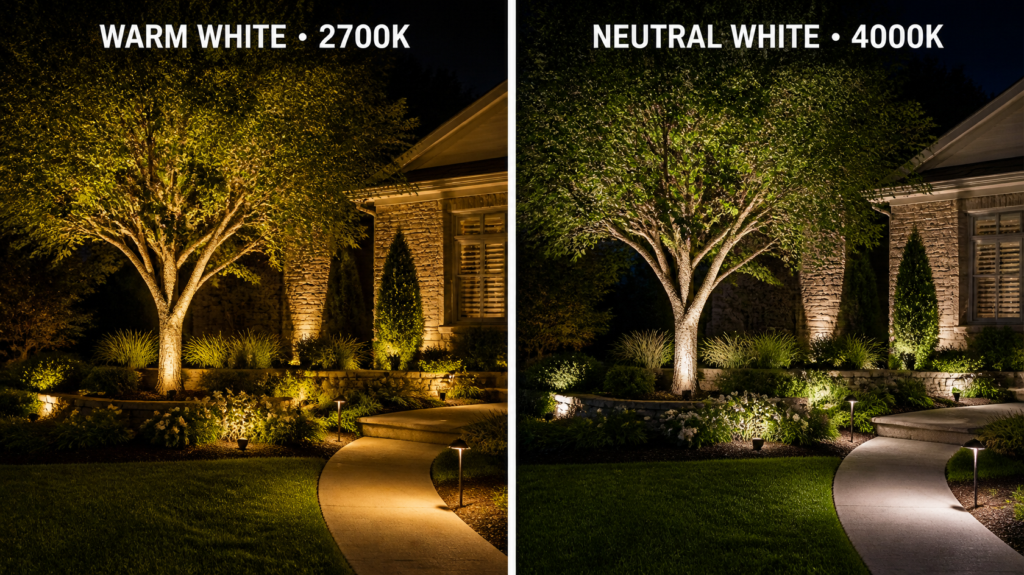
Color temperature is measured in Kelvins (K). For landscape lighting, most professional installations use warm or neutral white. Here’s how to think about the range:
| Color Temp | Kelvin Range | Appearance | Best Used For |
| Warm White | 2700K–3000K | Soft, golden, candlelight-like | Residential homes, garden beds, paths the most used range in JC residential work |
| Neutral White | 3500K–4000K | Clean, natural, balanced | Modern architecture, commercial properties, high-contrast hardscaping |
| Cool White / Daylight | 5000K–6500K | Bright, blue-tinted, clinical | Security lighting, commercial parking rarely used in residential landscape lighting |
The majority of professional residential landscape lighting installations in Johnson County use 2700K–3000K. It reads as warm and welcoming rather than bright or institutional. If your home has a modern or contemporary aesthetic, 3000K–4000K gives a cleaner look without crossing into industrial territory.
Landscape Lighting Design Tips for Johnson County Homes
Good landscape lighting design is about restraint and intention. The goal is to accent the right features not to illuminate everything at maximum brightness. These are the principles professional designers use:
1. Light the Feature, Not the Fixture
Every fixture should disappear in daylight. The light it casts is the point, not the hardware itself. When you can see fixtures from the street during the day especially path lights in a long row the installation looks cluttered. Space path lights 8–12 feet apart rather than 3–4, and choose fixtures with a low profile relative to the bed height they’re in.
2. Use the Rule of Three for Focal Points
Group focal-point lighting in odd numbers. Three uplights on a specimen tree, three accents on an architectural element, five path lights down a curved walk. Even numbers read as symmetrical and static; odd numbers read as natural and dynamic. This is a simple rule that dramatically improves how a lighting design reads from the street.
3. Layer Three Light Levels
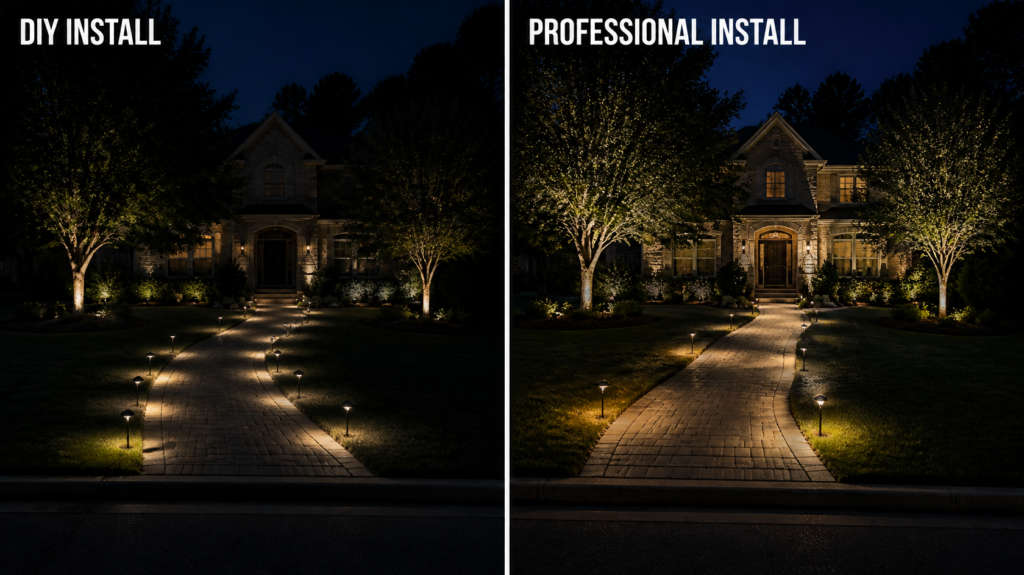
A well-designed landscape lighting system has three layers: (1) ambient light broad, low-intensity light that sets the overall brightness level of the yard, (2) accent light focused beams that highlight specific features, and (3) task light practical light on steps, entries, and paths. Most DIY installs only have one layer. Professional designs use all three.
4. Avoid Over-Lighting
More fixtures rarely means a better-looking result. A front yard with 20 path lights crammed 3 feet apart looks like a runway, not a garden. Start with less than you think you need, evaluate the result, and add. Professional installers typically put fewer fixtures than homeowners expect but place them more precisely.
5. Account for Seasonal Plant Change
Johnson County landscapes change significantly from April through November. A tree that provides dense canopy in July is skeletal in December. Design lighting to look intentional year-round: uplighting deciduous trees from multiple angles maintains visual interest in winter; path lighting that works with spring perennials also works in bare-bed winter.
How Much Does Landscape Lighting Cost in Johnson County?
Cost varies significantly based on fixture count, fixture quality, system complexity, and whether you’re doing it yourself or hiring a professional. Here’s the realistic range for Johnson County:
| Scenario | DIY Cost | Professional Install Cost | Notes |
| Small front yard (8–10 fixtures) | $300–$600 | $1,200–$1,800 | Path lights + 2–3 uplights. DIY uses entry-level fixtures. |
| Full front property (15–20 fixtures) | $600–$1,200 | $2,000–$3,500 | Transformer + multi-zone. Professional uses commercial-grade fixtures. |
| Full property front + back (25–40 fixtures) | $1,000–$2,500 | $3,500–$6,500 | Multi-transformer or high-wattage single. Buried cable throughout. |
| Permanent LED upgrade (Oelo) | N/A pro only | $1,200–$2,500 | Roofline permanent LED. Replaces seasonal Christmas lights. |
| Commercial or estate | Varies | $5,000–$20,000+ | Large scope; zoned; commercial-grade components throughout. |
| Why professional installs cost more than DIY and why they last longerThe gap between DIY and professional cost isn’t just labor. Professionals use commercial-grade fixtures solid brass, copper, or high-grade aluminum that last 10–20 years outdoors. Big-box store fixtures use cast zinc and plastic that oxidize, crack, and fail in 2–5 years in Johnson County’s temperature swings (-10°F to 105°F). A $1,500 DIY install replaced every 4 years costs more over a decade than a $3,000 professional install that lasts 15. |
DIY vs. Professional Landscape Lighting: Which Is Right for You?
Low-voltage landscape lighting is one of the more accessible outdoor electrical projects for homeowners. The 12V system means no electrician permit required, no dangerous voltage, and simple connector installation. But ‘accessible’ doesn’t mean ‘simple to do well.’
| Factor | DIY | Professional Install |
| Difficulty | Moderate transformer wiring, cable burial, connector installation | Handled design, layout, install, calibration all done for you |
| Time | 1–2 days for a typical front yard | 4–8 hours for a professional crew |
| Fixture quality | Consumer-grade (big-box) 2–5 year lifespan typical | Commercial-grade brass/copper 10–20 year lifespan typical |
| Design quality | Self-designed common pitfalls: voltage drop, over-lighting, wrong fixture placement | Professionally designed 15+ years of local JC property experience |
| Voltage drop management | DIY must calculate cable runs manually errors cause uneven brightness | Engineered and tested during install balanced across all runs |
| Warranty | Manufacturer warranty on fixtures only | Workmanship warranty on full installation + fixture warranty |
| Best for | Small projects (6–10 fixtures), budget-conscious, comfortable with outdoor wiring | Full-property designs, large trees, buried cable, multi-zone systems |
The honest answer: for a small front-yard path light install with 6–8 fixtures and a single transformer run, a competent homeowner can do this well in a weekend. For anything involving 15+ fixtures, buried cable across a full property, mature trees, or multi-zone design, a professional installation typically produces better results and lasts longer.
See our full landscape lighting services
Tropical Lighting Serves All of Johnson County, KS
Tropical Lighting is a Kansas City metro-based outdoor lighting company serving Johnson County homeowners and businesses since 2011. We install low-voltage landscape lighting, permanent Oelo LED systems, and holiday lighting across the full JC service area:
| Overland Park | Leawood | Lenexa | Olathe |
| Prairie Village | Shawnee | Mission | Merriam · Gardner · Spring Hill |
See our full landscape lighting services
| Question | Answer |
| What is low-voltage landscape lighting? | Low-voltage landscape lighting is an outdoor lighting system that runs on 12V AC power stepped down from standard 120V by a transformer. It’s the standard for residential outdoor lighting because it’s safe (12V won’t cause serious injury), energy-efficient (LED uses 75–80% less power than incandescent), and durable (LED fixtures last 25,000–50,000 hours). |
| How much does landscape lighting cost in Johnson County? | A professionally installed low-voltage landscape lighting system in Johnson County typically starts at $1,200 for a small front-yard design (8–12 fixtures) and ranges to $3,500–$6,500 for a full property. Costs vary based on fixture count, fixture quality, and system complexity. All Tropical Lighting jobs include a free on-site estimate with a written quote before work begins. |
| What is the best color temperature for landscape lighting? | Most professional residential landscape lighting uses 2700K–3000K (warm white). It reads as warm and welcoming. Homes with modern architecture often use 3000K–4000K for a cleaner, more neutral look. Cool white (5000K+) is rarely used in residential landscape lighting it reads as bright and institutional. |
| How long does a landscape lighting system last? | Commercial-grade landscape lighting systems using solid brass, copper, or marine-grade aluminum fixtures typically last 15–20 years. Transformer lifespan is 10–15 years. LED fixtures are rated for 25,000–50,000 hours (25+ years at 4 hours/night). Consumer-grade fixtures from big-box stores typically last 2–5 years in Johnson County’s temperature extremes. |
| Can I install landscape lighting myself? | For small projects (6–10 fixtures, single-zone), a low-voltage landscape lighting system is accessible to a DIY homeowner. For larger projects 15+ fixtures, buried cable across a full property, mature trees, multi-zone design professional installation typically produces better results, lasts longer, and costs less over a 10-year horizon than repeated DIY replacement. |
| Does Tropical Lighting serve my area of Johnson County? | Tropical Lighting serves all of Johnson County, KS including Overland Park, Leawood, Lenexa, Olathe, Prairie Village, Shawnee, Mission, Merriam, Gardner, and Spring Hill. We’ve been operating in the KC metro since 2011. Use the contact form at tropical-lighting.com/contact-outdoor-lighting-mission-ks/ to request a free estimate. |