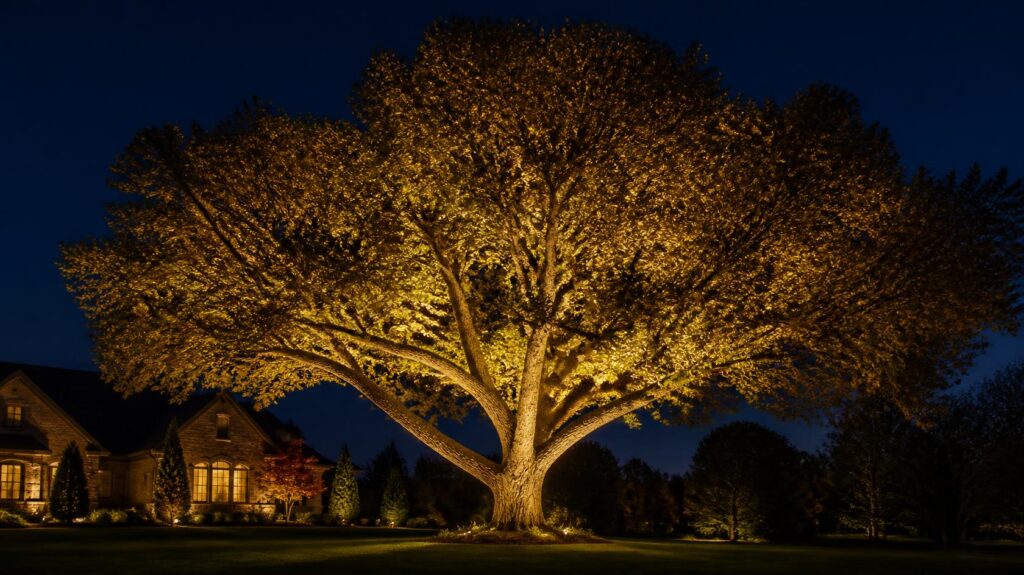
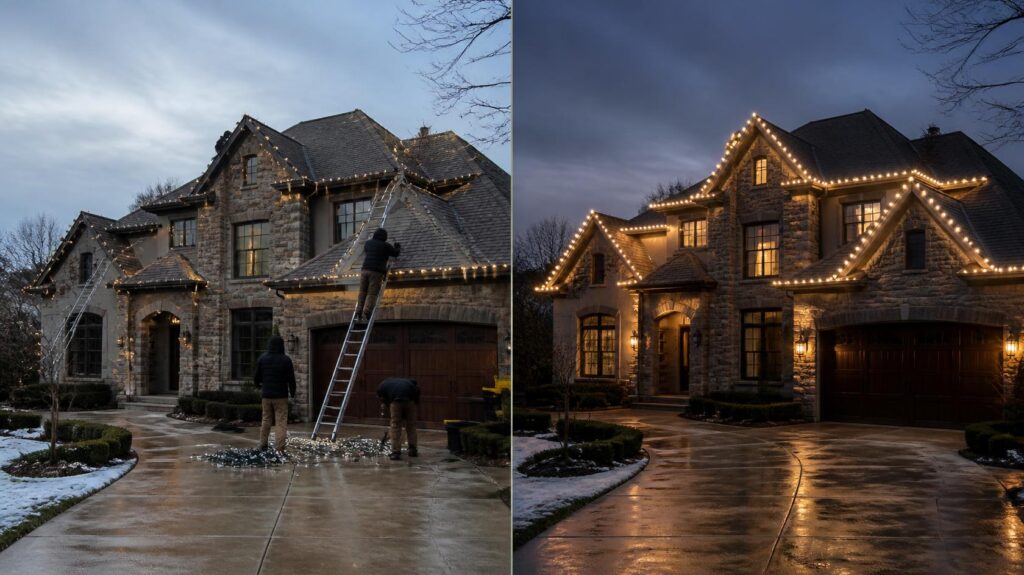
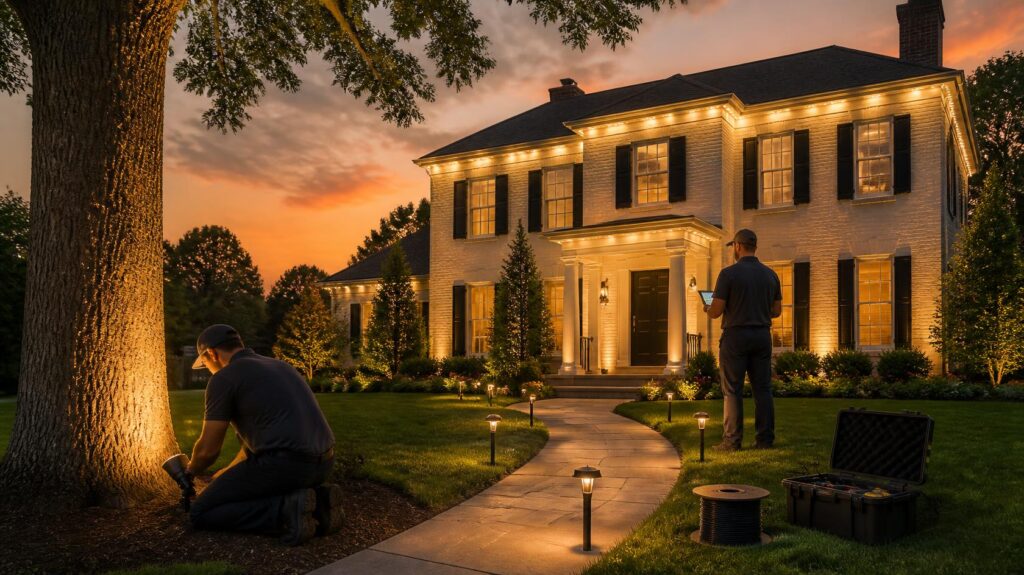
Most homeowners who ask about outdoor lighting want to know one thing: how do I make my yard look the way it does in the photos? The answer is almost always tree uplighting. A well-lit oak or maple at the front of your property changes the entire look of the house after dark it anchors the landscape, frames the home, and creates depth that a floodlight pointed at your garage door never will.
This guide covers exactly how tree uplighting works: which fixtures to use, where to place them, what beam angle and color temperature to choose, and how to approach different types of trees. We install landscape lighting across Johnson County, KS from Overland Park and Leawood to Mission and Prairie Village and we’ve been doing it since 2011. These are the same techniques our crew uses on every install.
WHAT IS TREE UPLIGHTING?
Tree uplighting means placing a ground-mounted fixture at or near the base of a tree and aiming it upward into the canopy. The fixture is hidden recessed in the ground or low-profile at grade level and the light source itself is rarely visible from a normal viewing angle. What you see is the illuminated tree, not the hardware.
Uplighting is different from floodlighting. A floodlight throws a wide wash of light in a general direction. Uplighting is aimed and controlled the beam angle, fixture distance, and aiming point are all chosen to shape how the tree looks. Done correctly, the result is dramatic and architectural without looking overlit or artificial.
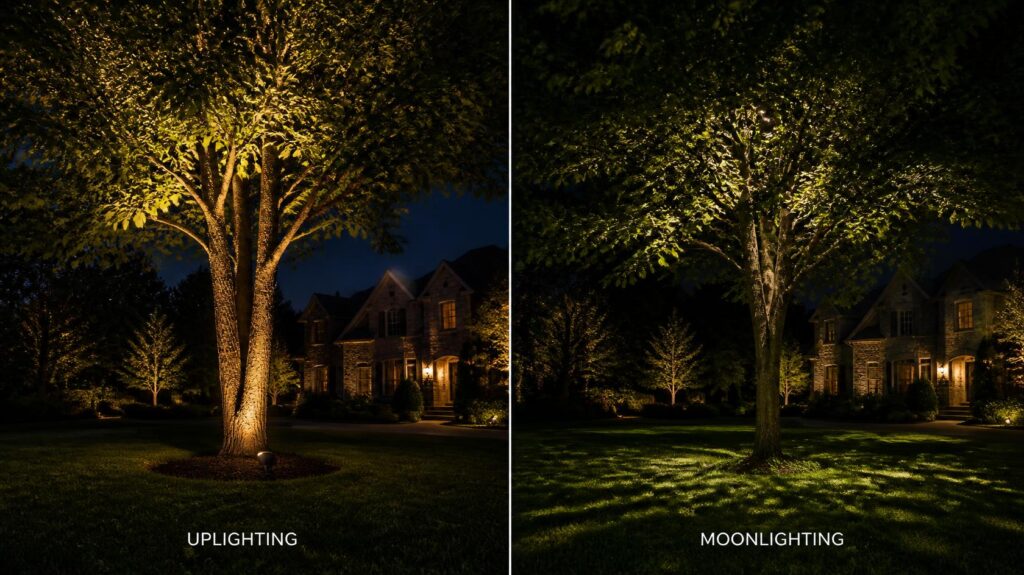
Uplighting is also different from downlighting (sometimes called moonlighting), where a fixture is mounted in the tree canopy and aimed downward to cast soft, moving shadows on the ground below. Both techniques are useful and we cover them both but this guide focuses on ground-level uplighting, which is the most common starting point for Johnson County homeowners.
BEAM ANGLE: THE MOST IMPORTANT VARIABLE
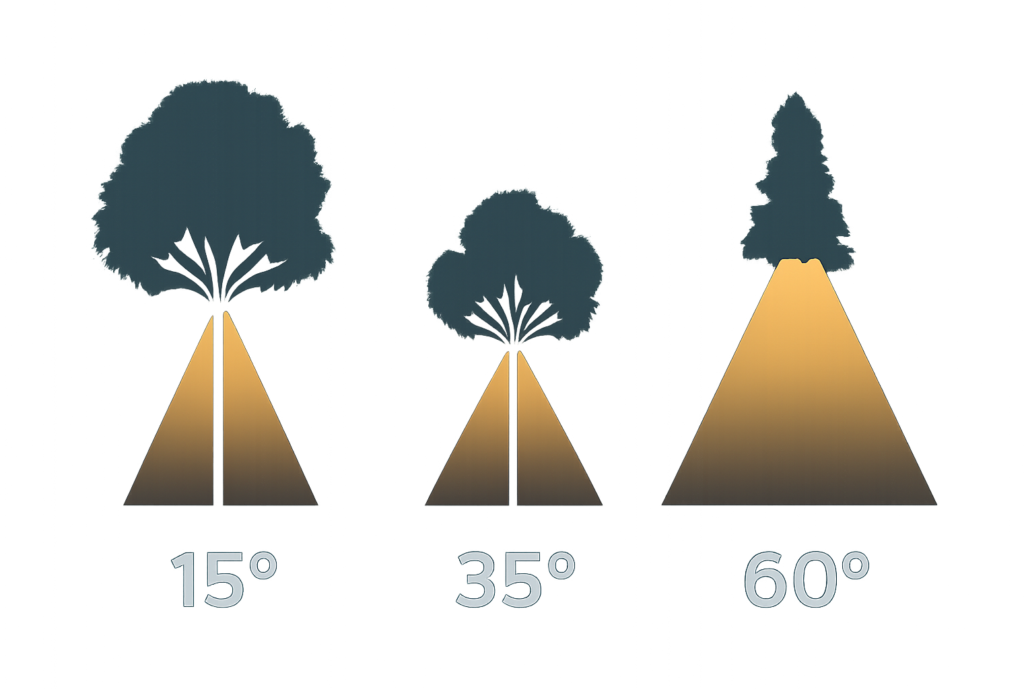
Beam angle determines how wide the light spreads as it travels from the fixture to the canopy. Get it wrong and you either light a small bright patch at the base of the trunk or throw light so broadly that nothing looks intentional. Here’s how to match beam angle to tree size:
| Beam Angle | Best For | What It Does |
| 15° | Large deciduous trees (60–100 ft) trunk lighting | Narrow column of light up the trunk from base to where major branches begin. Usually one of several fixtures on a large tree. |
| 35° | Small to medium trees (under 30 ft) general uplighting | Most common all-purpose angle. Lights trunk and lower canopy. Use one fixture on a small tree, two in a cross-light on a medium tree. |
| 60° | Medium/large canopies, conifers, downlighting | Wider wash that reaches a larger canopy from a distance. Also used for downlighting from the canopy aimed at the ground. |
| Note: beam spread widens with distance. A 15° fixture may spread to 20–30° by the time it reaches a tall canopy 30–40 ft up. Account for this when positioning a narrow beam aimed too close to the trunk may wash the bark but miss the canopy entirely. |
FIXTURE PLACEMENT: HOW FAR FROM THE TRUNK
The most common uplighting mistake is placing the fixture too close to the trunk. When a fixture sits right at the base, it lights two to three feet of bark and leaves the rest of the tree in darkness exactly the opposite of the intended effect.
The general rule: keep fixtures at least 18 to 24 inches from the trunk. For larger trees with spreading canopies, move the fixture further out sometimes to the drip line (the outer edge of the canopy) or beyond. The goal is to let the beam escape the lower trunk and travel upward into the branches.
| Tree Size | Fixture Distance from Trunk | Fixture Count | Notes |
| Small (under 20 ft) | 18–24 in | 1–2 fixtures | One 35° accent for a tree viewed from one side. Add a second if it’s viewed from two angles (street and driveway). |
| Medium (20–40 ft) | 24–48 in | 2 fixtures | Cross-lighting with two 35° lights gives better canopy coverage than one 60°. One on each side. |
| Large (40–60 ft) | 4–6 ft from trunk, plus drip-line fixtures | 3–5 fixtures | One 15° at base for trunk, two to three 35°–60° fixtures aimed up into canopy from outside it. |
| Very large (60–100 ft) | 6+ ft, plus canopy-mounted fixtures | 4–6 fixtures | Combine ground-mount and tree-mounted fixtures. Use 15° at base, 35° and 60° aimed at canopy, plus one to two fixtures mounted in the tree. |
| Dense conifer (fir, spruce) | Drip line or beyond | 2 fixtures | Aim 60° fixtures from opposite sides at the tree profile rather than up into the canopy. Light the exterior silhouette. |
COLOR TEMPERATURE: WARM IS ALMOST ALWAYS RIGHT
Color temperature is measured in Kelvin (K). Lower numbers = warmer, more amber light. Higher numbers = cooler, bluer-white light. For tree uplighting, you want warm. Here’s why:
A cool white light (4000K or above) makes foliage look washed out and artificial under most conditions. The goal of uplighting is to make the tree look better at night than it does in daylight not to replicate daylight. Warm light enhances the natural color of bark, leaves, and branches rather than bleaching them.
| Color Temp | Appearance | Best For |
| 2000K–2200K | Very warm amber, close to candlelight | Small ornamental trees, Japanese maples, flowering dogwood. Intimate, garden-like feel. |
| 2700K–2800K | Warm white, slight amber tone | Most deciduous trees in Johnson County yards. The most common and versatile choice. |
| 3000K | Crisp warm white, contemporary | Larger feature trees, modern architecture, river birch or ornamental pear. |
| 3500K+ | Neutral to cool white | Rarely used in residential uplighting. Can look harsh or hospital-bright on organic material. |
| Color Rendering Index (CRI) matters too. A CRI of 90 or above means the light renders colors more accurately so green foliage looks genuinely green and bark looks like bark, not a grey shadow. Specify CRI 90+ when sourcing fixtures; most commercial-grade LED landscape fixtures meet this. |
TREE-BY-TREE: HOW TO APPROACH COMMON JOHNSON COUNTY TREES
Johnson County yards have a recognizable mix of trees. Here’s how to approach the species we see most often:
| Tree | Beam Angle | Color Temp | Approach |
| Mature oak (large deciduous) | 15° at trunk + 35°–60° canopy | 2700K–3000K | 3–5 fixtures. One narrow beam up the trunk from close in; two to three wider beams aimed up through canopy from 4–6 ft out. Creates strong vertical emphasis. |
| Red or silver maple | 35° | 2700K | Two fixtures in cross-light. Place 24–48 in from trunk at opposing angles. The spreading canopy reflects light well with warm temps. |
| River birch (multi-stem) | 35°–60° | 3000K | Aim at the multiple stems from ground level. The white/peeling bark reflects light beautifully and looks especially good with crisp 3000K. |
| Ornamental pear (Bradford) | 35° | 2700K–3000K | Single fixture is often enough for smaller specimens. Place to emphasize the full-canopy oval shape. Avoid overlighting these trees already have a clean silhouette. |
| Flowering dogwood | 35° | 2000K–2700K | Uplight from below the canopy. Use warm 2000K–2200K to complement the white/pink blossom color. One to two fixtures. |
| Japanese maple | 35° | 2000K–2200K | Place fixture under the canopy, very close to the drip line. Low Kelvin brings out the deep red/purple foliage. One fixture usually sufficient. |
| Spruce/fir (conifer) | 60° (two sides) | 2700K | Do not uplight from directly below the dense foliage blocks the beam. Place two 60° fixtures on opposite sides aimed at the tree profile. Light the exterior form. |
| Pecan (large native) | 15° + 35° + canopy mount | 2700K–3000K | Same approach as large oak. Pecans grow large; plan for 4–5 fixtures on a mature specimen. |
| Dense evergreen (arborvitae, juniper) | 60° (from drip line) | 2700K | Place from drip line or beyond. These absorb light rather than reflecting it, so go slightly higher wattage than you would for deciduous. |
UPLIGHTING VS. MOONLIGHTING: WHICH ONE?
Moonlighting is the other major tree lighting technique. Instead of a ground fixture aimed up, a small LED fixture is mounted in the canopy 20 to 35 feet off the ground and aimed downward. The light filters through the leaves and casts soft, dappled shadows on the ground below. When there’s a breeze, the shadow pattern moves.
The two techniques create different effects and suit different situations:
| Uplighting | Moonlighting | |
| Effect | Dramatic, focal point. Tree becomes an architectural element. | Subtle, atmospheric. Soft dappled shadows on ground. More naturalistic. |
| Best use | Front-yard feature trees, trees visible from street, entry framing. | Outdoor living areas patios, seating areas, pergolas under large trees. |
| Installation | Ground-mount fixtures. Minimal complexity. | Requires arborist or certified climber to mount in canopy. More labor. |
| Fixture height | Ground level | 20–35 ft up in canopy |
| Tree types | Works on most trees | Best on large open-canopy deciduous trees. Not effective on dense conifers. |
| Cost | Lower (ground fixtures only) | Higher (climbing + mounting hardware + fixture) |
| Best practice: use uplighting on feature trees and moonlighting on the large tree that overhangs your primary outdoor seating area. Many Johnson County homes with mature oaks or pecans benefit from both on the same tree a dramatic uplight from the ground and a moonlight effect from above for the patio below. |
THE 5 MOST COMMON TREE UPLIGHTING MISTAKES
These are the things we fix most often when a homeowner had their lighting done by a general contractor or did it themselves:
| # | Mistake | How to Fix It |
| 1 | Fixture too close to trunk | The beam lights 2–3 ft of bark and stops. Move the fixture 18–24 in minimum from the trunk for small trees, 4–6 ft for large. The goal is to let the beam escape the lower trunk and reach the canopy. |
| 2 | Beam angle too narrow for the tree | A 15° spot on a wide-spreading maple will light a column the width of the trunk while leaving the canopy dark. Match beam angle to canopy spread: 35° for most trees, 60° for large or spreading canopies. |
| 3 | Color temperature too cool | A 4000K or 5000K lamp makes foliage look grey and unnatural. Stay between 2700K and 3000K for almost all Johnson County residential tree uplighting. |
| 4 | Overlighting shrubs ahead of trees | Shrubs lit at high intensity before trees are addressed creates a visual hierarchy that’s hard to fix without redoing the whole system. Light trees first, then calibrate shrubs lower. |
| 5 | Visible glare from fixture | A fixture placed too high or angled toward a viewing angle (the street, the front door, a window) creates uncomfortable glare. Use cowls or shields on the fixture, and check every installation from multiple viewing angles at night. |
TREE UPLIGHTING IN JOHNSON COUNTY, KS: WHAT’S DIFFERENT
Johnson County homes tend to have more mature tree canopies than most suburban markets particularly in Leawood, Mission Hills, Prairie Village, and older Overland Park neighborhoods. Mature oaks, pecans, and river birch are common. The design challenge in these yards isn’t finding a tree worth lighting it’s choosing which ones not to light so the yard doesn’t become a runway of glowing trees with no visual hierarchy.
A few considerations specific to this area:
Clay and compact silt soils in Johnson County can make running wire underground more labor-intensive than sandy soils. We use conduit sleeves on all underground wire runs to allow future service access without digging.
Seasonal foliage change affects uplighting substantially. A river birch that looks dramatic in full leaf from June through October becomes a bare-branched skeleton in January. This isn’t necessarily a problem bare winter branching can look equally compelling with uplighting but it’s worth planning for. We calibrate transformer schedules seasonally.
Most Johnson County homes on corner lots or with circular driveways need lighting that reads well from two or more viewing angles from the street and from the driveway approach. This affects fixture placement and count.
WHAT A PROFESSIONAL TREE UPLIGHTING INSTALLATION INCLUDES
When we install tree uplighting for a Johnson County homeowner, here’s what’s included in the process:
| 1 | Free on-site consultation and design: We walk the yard with you, identify the feature trees, and sketch the fixture placement plan. We show starting price ranges before the visit, so you know what to expect. |
| 2 | Fixture selection: We specify commercial-grade LED fixtures rated at 50,000 hours or more, sized to the tree. Not hardware-store product. |
| 3 | Underground wire runs with conduit sleeves: All buried wire goes in conduit for future service access. We route wire to avoid damaging root systems. |
| 4 | Multi-zone transformer setup: Each tree or tree group can run on its own circuit with its own schedule. Landscape lighting, pathway lighting, and facade lighting run separately. |
| 5 | Nighttime calibration: We do final aiming and intensity adjustment after dark, with you present. Most homeowners change their minds about at least one fixture angle at this step. |
| 6 | Written warranty documentation: Fixture manufacturer warranty on parts. Our labor warranty on installation. |
| 7 | Starting price range for tree uplighting in Johnson County: $400–$900 per tree depending on tree size, fixture count, and wire run distance. Most front-yard packages with one to three trees run $1,200–$2,800. |
| Ready to see what your yard’s trees look like at night?We offer free on-site estimates for Johnson County homeowners. No form fill required to see starting price ranges.→ Schedule a Free Estimate |
FAQ: TREE UPLIGHTING IN JOHNSON COUNTY
These are the questions we hear most often from Johnson County homeowners before their first uplighting install:
Q: How far should uplights be from the tree?
At least 18 to 24 inches from the trunk for small trees (under 20 feet). For larger trees, move out to 3 to 6 feet or beyond the drip line. The common mistake is placing the fixture too close, which lights only the trunk base and leaves the canopy dark. The fixture distance should let the beam travel upward and spread to cover the main branching structure.
Q: What color light is best for uplighting trees?
Warm white in the 2700K to 3000K range works for almost every Johnson County residential tree. For ornamental trees with colorful foliage (Japanese maple, flowering dogwood), go warmer 2000K to 2200K. Avoid anything above 3500K for residential tree lighting; it makes organic material look grey and artificial. CRI of 90 or higher matters as much as color temperature.
Q: How many lights do I need for a tree?
One to two fixtures for small trees. Two to three for medium trees using cross-lighting. Three to six fixtures for large mature trees, combining a narrow beam at the trunk base with wider beams aimed up into the canopy. For very large trees (60 feet or more), add one to two canopy-mounted fixtures. These are starting points the actual fixture count depends on tree spread, viewing angles, and whether other landscape elements are nearby.
Q: What is the difference between uplighting and moonlighting?
Uplighting places a fixture at ground level aimed upward dramatic focal point, architectural effect. Moonlighting mounts a fixture in the tree canopy (20 to 35 feet up) aimed downward, creating soft dappled shadows on the ground. Uplighting requires less installation complexity and works on any tree. Moonlighting requires a certified crew to work at height and is most effective under large open-canopy deciduous trees. Many Johnson County homeowners use both on the same tree.
Q: Can I uplight trees myself or do I need a professional?
Small, straightforward installations with one or two fixtures and a simple transformer connection are DIY-feasible. The challenges are underground wire runs (conduit requirement in most Johnson County municipalities), transformer sizing (undersizing is the most common DIY error), nighttime calibration (you can’t calibrate beam angles in daylight), and fixture quality (most hardware store landscape lights are rated at 15,000 to 20,000 hours vs. commercial-grade at 50,000+). For anything with three or more trees, underground runs, or a multi-zone transformer, professional installation pays for itself in fixture lifespan and fixture count.
Q: How much does tree uplighting cost in Johnson County?
Starting at $400 to $900 per tree for a professional installation with commercial-grade LED fixtures, underground wire runs, and transformer connection. Most Johnson County front-yard packages with one to three feature trees run $1,200 to $2,800 including design, installation, and nighttime calibration. Full-property packages combining tree uplighting, pathway lighting, and facade lighting typically run $3,500 to $8,000+ depending on scope. We publish price ranges without requiring a quote form.
GET A FREE TREE UPLIGHTING ESTIMATE IN JOHNSON COUNTY
We’ve installed landscape lighting across Johnson County since 2011 Overland Park, Leawood, Mission, Prairie Village, Shawnee, Lenexa, and every city in between. Every installation starts with a free on-site estimate and a written quote. We do nighttime calibration on every project so the final result matches what you had in mind, not just what looked right on paper.
If you want to see what your yard’s trees look like lit up before committing, we can walk the property with you after dark and show you the effect with a test fixture. No obligation.